Why Is Thr Royal Family Always the Same at Thraz Rennesancs
How the British Imperial Family Became a Global Brand
It's difficult to imagine the monarchs of Kingdom of saudi arabia and Thailand selling souvenir tchotchkes in quite the same way.
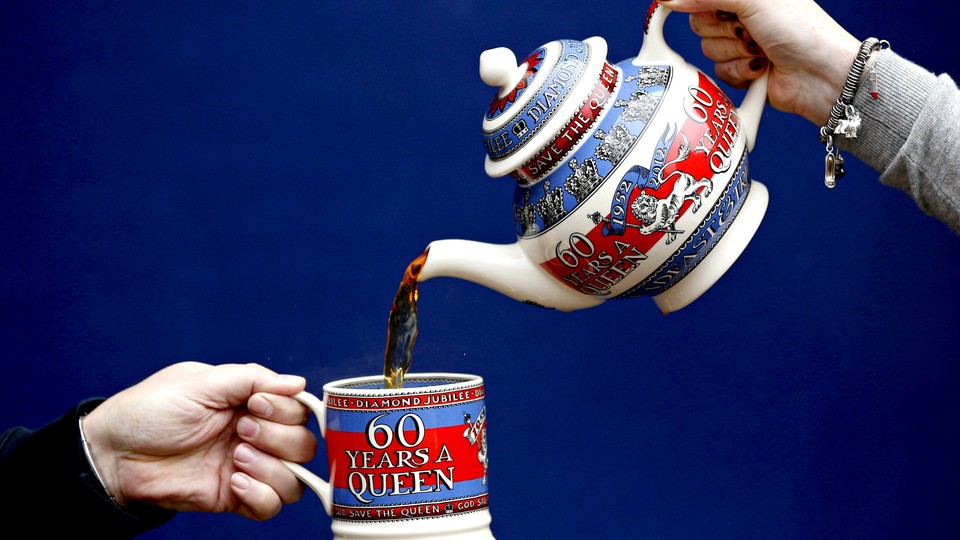
Regardless of how people felt well-nigh the British royal family, they would have been hard-pressed to avert the epitome of Queen Elizabeth II in London—and in much of the globe—during the tardily spring of 2012. The year marked the queen's "diamond jubilee," celebrating 60 years with Elizabeth 2 on the throne. From an optician's window on Kensington High Street, the monarch appeared encased in an ornate gold frame and surrounded by signs proclaiming a £fifty discount. Nearby, on Piccadilly Circus, photos taken at different stages of her life beamed from souvenir shortbread tins, coffee mugs, tea towels, and miscellaneous tchotchkes.
But the brand of the British royal family doesn't belong to Great britain alone. Fifty-fifty as the world has seen a marked decline in the number of crowned heads, specially in Europe, since the beginning of the 20th century, Queen Elizabeth Ii and her family proceed to attract worldwide fascination. In 2011, millions of people in 180 countries watched the purple nuptials of Prince William and Kate Middleton. During the opening ceremonies of the London Olympics the following year, 900 meg viewers worldwide watched Elizabeth 2 play herself in a skit delivering undercover orders to the British spy James Bond (played past Daniel Craig) before parachuting with him, via stunt double, into Olympic Stadium. Meanwhile, British tabloids and online media beam royal missteps and debacles effectually the earth.
It is hard to imagine, say, the monarchs of Saudi arabia, Thailand, or Norway every bit global brands in quite the same mode. And while the successful branding of the British majestic family is partially a production of Britain'south historic role in the world, it also has causes closer to home—in the evolving relationship between British royals and their subjects.
* * *
"Imperial-watching" has historically attracted much of the denizens in what is now known as Cracking United kingdom of great britain and northern ireland. Until the wide-scale development of mass media in the late 19th century, people typically learned about royal activities through proclamations "nailed on the marketplace cantankerous, read aloud by a sheriff or other local official, or circulated and reported in [a] hamlet or alehouse," co-ordinate to the historian Kevin Sharpe in Selling the Tudor Monarchy. Until recently, many royal rituals were regarded as private, and sometimes secretive, affairs of land rather than occasions for public cultural commemoration. Merely as more than citizens migrated to London and its environment, their presence increased at the processionals that preceded coronations, funerals, and triumphal civic pageants celebrating victories over enemies on the battlefield, co-ordinate to historical records.
Yet royal-watching has not ever been a tourist activeness. From 1066 until 1743, when George II was the last king to fight in boxing, the British were involved in over 50 wars. During much of this "warrior male monarch" era, royal-watching oft meant watching out for monarchs—or their armies. Kings and queens were under constant pressure to replenish their royal treasuries and to rouse and replace lost troops, equipment, and transportation. With warrior kings frequently as likely to plunder their own subjects as protect them, the notion of engaging in whatever kind of royal-themed tourist experiences, or of collecting souvenirs or traveling to seek regal encounters, would take been unfathomable.
After 1688, the British Parliament began to abate the power of the monarchy through increasing ramble restrictions. At the same time, two other key factors reshaped the nature of royal-watching. The function of the warrior king waned by the stop of the 18th century, replaced by the decidedly more passive role of the monarch every bit diplomat. Meanwhile, a structured and stable class system arose. For the lower classes who lived outside London, regal-watching typically involved lining the hedgerows forth Uk's village roads, where monarchs and their entourages traveled. Within the aristocracy, withal, a more formal and demanding type of interaction emerged. During the 19th and part of the 20th centuries, the most of import families in society were expected to host elaborate weekend parties at their estates and to resign themselves to royals inviting themselves over. Of course, most families regarded hosting members of the ruling grade of their country as a great social achievement. Sometimes, nonetheless, the state of affairs devolved into a classic example of existence careful what 1 wished for. In the late 19th century, the lavish tastes of Prince Albert Edward (later Male monarch Edward Seven) meant that entertaining him cost £v,000 to £10,000 (in 19th-century pounds) per weekend. It was rumored that Lord Suffield, a close friend of Albert's, grew so desperate for relief from this duty that he burned and gutted his own home.
Between the two globe wars, the British aristocracy was gradually but irrevocably felled past the combination of a global depression, a refuse in demand for British goods around the world, the battlefield deaths and horrific injuries incurred during World War I by many sons and heirs of the great houses, and crippling changes in estate-taxation laws. By World War II, large weekend house parties had died out, shifting the locus of the royal family unit'due south entertainment to their own palaces and to events such as the annual presentation of upper-class debutantes at court.
The decline of the aristocracy also meant that the British upper class began to interact with the royal family unit at events that members of lower social classes could also nourish. At significant sporting events, such as Wimbledon and Royal Ascot, for example, tickets are available to the general public. Distinctions in the means the social classes interact are nevertheless maintained even at these more accessible events, but sometimes class boundaries disappear completely effectually their fringes. In 2005, after the wedding of Prince Charles and Camilla Parker Bowles in Windsor, many guests in their tails, top hats, and "fascinators" dined at the bistro chain Café Rouge in Windsor & Eton Key train station—at tables alongside more than plebeian spectators who had stood backside the barricades, waving as the couple's limousine sped off.
* * *
Today, processions of monarchs and dignitaries at the coronation of a new British monarch mark the occasion every bit a truly global recognition of the British crown. It is non just the ceremony that's international. The British scholar John Balmer, who has done extensive work on "monarchic brands," has observed that considering the queen is the sovereign of the United Kingdom and 15 other realms (not to mention the head of the Democracy of Nations, with 53 member countries), she is, de facto, "sixteen queens rolled into ane."
This international reach of the British monarchy, especially as it is manifested in consumer culture, highlights a cardinal difference between that imperial family unit and other monarchies around the globe. For example, it is illegal to speak sick of Thailand'due south royal family, and beingness caught doing so can result in jail time. And so information technology is highly unlikely any Thai retailer would risk offering, say, a coffee mug that pokes even gentle fun at King Bhumibol Adulyadej's extreme wealth. It might be causeless that the few remaining monarchies in Europe would exist motivated to tailor their majestic-related trade to a broad assortment of touristic tastes. But the range of imperial-themed goods, services, and experiences on the continent in no way approaches what can be caused in Uk. Although Oslo'southward main street—at the crest of which is the royal palace—is awash in tourist shops and global retailers like the Hard Rock Cafe, the average number of majestic souvenirs found in establishments along the street is essentially goose egg. It isn't that Norwegian retailers spare their visitors kitsch; their shops are stuffed with sacred to silly varieties of moose, reindeer, Vikings, Laplanders, and a bevy of trolls. Merely two weeks of exploring tourist and antique shops in Norway's interior and on its coastline revealed that royal merchandise is a bleep on the country'south retail radar.
Contrast this muted mercantile response with the types of artifacts people can find in Britain to satisfy the "curious psychological need for royal narratives and for imagined participation in majestic lives," equally the tourism scholar Philip Long wrote in Royal Tourism. Even when Charles, prince of Wales, and his wife Diana divorced in 1996, and the resulting negative public sentiment led many to assume that the hereafter of the monarchy was tenuous, manufacturers responded with commemoratives of that event. 1 souvenir plate even satirized the divorce by sporting an image of the couple with a large black cleft down the eye.
Marketplace representations of the British royal family run the gamut from what the anthropologist Helaine Silverman labels "portable royalty" (due east.g., teaspoons, thimbles, java mugs, and key chains) to large-scale, expensive choices—including refrigerators boasting full-sized William and Catherine engagement-photo decals, and replicas of royal housewares and jewelry fabricated of golden, silver, porcelain, and other fine materials priced in the thousands of pounds. For many people, the British monarchy reflects what the Scottish political theorist Tom Nairn calls the "glamour of backwardness."
Between 2012 and 2014, the diamond jubilee, Prince George'due south birth, William and Catherine's tour of Australia and New Zealand, and their subsequent whirlwind visit to New York Urban center helped sustain involvement in visits to sites associated with the monarchy. There are numerous historically significant and (by and large) well-trodden royal venues in Britain, including Buckingham Palace, Kensington Palace, and Westminster Abbey. Merely at that place are too four almanac racing events, each on a unlike continent, that bear Queen Elizabeth'due south proper noun. There is a "Queen Elizabeth Land" in Antarctica, a Queen Elizabeth Two September 11th Garden in Lower Manhattan, and a statue of her posing with her ubiquitous handbag in Brisbane, Commonwealth of australia. Even the Kremlin, associated with the authorities that brought the Russian monarchy to a violent end, offered an exhibit in 2013 called "The 'Gilt Age' of the English language Court: From Henry Eight to Charles I."
Defenders of the monarchy oftentimes fence that it is a vital tourist depict. In truth, except for the specific records of how many people visit a detail site, it is very difficult to accurately appraise the economic impact of majestic tourism. The BBC'south quondam economics correspondent Evan Davies has asserted that 10 percent of all tourists visit the U.k. because of their interest in the majestic family, merely notes that many more "are attracted [to] Britain … equally a unique and glorious heritage centre, to which the monarchy makes an inestimable contribution." Doing abroad with the monarchy while retaining its trappings, for example, would likely not be as alluring for tourists, since the royal family unit acts, in the words of The Atlantic's Olga Khazan, "as a sort of charismatic megafauna for the entire royalty-tourism ecosystem."
The staff at St. James's Palace, the official royal residence, has gradually adopted more sophisticated marketing techniques to promote the royal family and tourist experiences related to the monarchy—efforts to which the queen and her relatives have occasionally contributed significantly. Foremost among these was the queen'southward determination in 1993 to open Buckingham Palace, the monarch's administrative headquarters, to the public, despite her desire to continue her public and individual lives singled-out. In 2013, foreign tourists ranked the tour of the palace as the tiptop "But in United kingdom" activity.
This article has been adjusted from Cele C. Otnes and Pauline Maclaran's new book, Majestic Fever.
Source: https://www.theatlantic.com/international/archive/2015/10/british-royal-monarchy-queen-elizabeth/411388/
0 Response to "Why Is Thr Royal Family Always the Same at Thraz Rennesancs"
Post a Comment